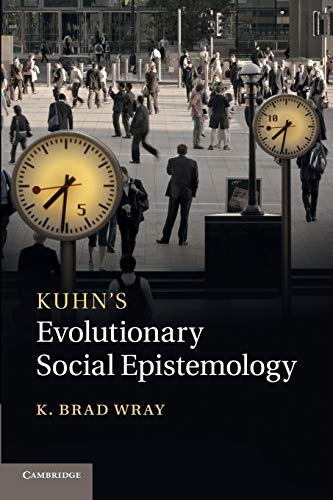
Kuhn's evolutionary social epistemology
Publication details: Cambridge : Cambridge University Press, 2014.Description: xiii, 229 pages : illustrations (black and white) ; 23 cmContent type:- 9781107632905 (pbk.) :
- 501
| Cover image | Item type | Current library | Home library | Collection | Shelving location | Call number | Materials specified | Vol info | URL | Copy number | Status | Notes | Date due | Barcode | Item reservations | Item reservation queue priority | Course reserves | |
|---|---|---|---|---|---|---|---|---|---|---|---|---|---|---|---|---|---|---|
|
|
George Adams Research Centre | Main | 501 WRA (Browse shelf(Opens below)) | Available | RM000203 | |||||||||||||
|
|
George Adams Research Centre | Main | 501 WRA (Browse shelf(Opens below)) | Available | RM000204 | |||||||||||||
|
|
George Adams Research Centre | Main | 501 WRA (Browse shelf(Opens below)) | Available | RM000202 |
Originally published: 2011.
Includes bibliographical references and index.
List of figures and table; Acknowledgements; Introduction: Kuhn's insight; Part I. Revolutions, Paradigms, and Incommensurability: 1. Scientific revolutions as lexical changes; 2. The Copernican revolution revisited; 3. Kuhn and the discovery of paradigms; 4. The epistemic significance of incommensurability; Part II. Kuhn's Evolutionary Epistemology: 5. Kuhn's historical perspective; 6. Truth and the end of scientific inquiry; 7. Scientific specialization; 8. Taking stock of the evolutionary dimensions of Kuhn's epistemology; Part III. Kuhn's Social Epistemology: 9. Kuhn's constructionism; 10. What makes Kuhn's epistemology a social epistemology?; 11. How does a new theory come to be accepted?; 12. Where the road has taken us: a synthesis; Bibliography; Index.
Wray argues that Kuhn provides a useful framework for developing an epistemology of science that takes account of the constructive role that social factors play in scientific inquiry. He examines the concepts of structure and explains the main characteristics of Kuhn's evolutionary epistemology and his social epistemology. Kuhn's Structure of Scientific Revolutions (1962) has been enduringly influential in philosophy of science, challenging many common presuppositions about the nature of science and the growth of scientific knowledge. However, philosophers have misunderstood Kuhn's view, treating him as a relativist or social constructionist. In this book, Brad Wray argues that Kuhn provides a useful framework for developing an epistemology of science that takes account of the constructive role that social factors play in scientific inquiry. He examines the core concepts of Structure and explains the main characteristics of both Kuhn's evolutionary epistemology and his social epistemology, relating Structure to Kuhn's developed view presented in his later writings. The discussion includes analyses of the Copernican revolution in astronomy and the plate tectonics revolution in geology. The book will be useful for scholars working in science studies, sociologists and historians of science as well as philosophers of science.
There are no comments on this title.