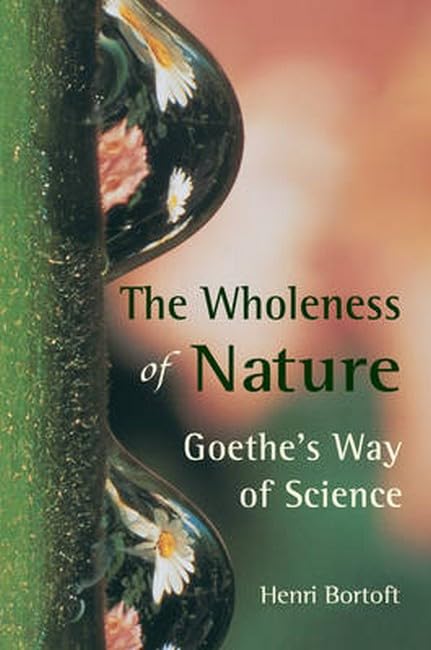
The wholeness of nature : Goethe's way of science
Publication details: Edinburgh : Floris, 1996.Description: xii, 419 p. : ill. ; 24 cmISBN:- 9780863152382 (pbk.) :
- 501
| Cover image | Item type | Current library | Home library | Collection | Shelving location | Call number | Materials specified | Vol info | URL | Copy number | Status | Notes | Date due | Barcode | Item reservations | Item reservation queue priority | Course reserves | |
|---|---|---|---|---|---|---|---|---|---|---|---|---|---|---|---|---|---|---|
|
|
George Adams Research Centre | Main | 501 BOR (Browse shelf(Opens below)) | Issued | 15/01/2027 | RM000119 | ||||||||||||
|
|
George Adams Research Centre | Main | 501 BOR (Browse shelf(Opens below)) | Issued | 15/01/2027 | RM000120 |
Browsing George Adams Research Centre shelves,Collection: Main Close shelf browser (Hides shelf browser)


Includes bibliographical references (p. 408-419).
Henri Bortoft examines the phenomenological and cultural roots of Goethe's ways of science. He argues that Goethe's insights, far from belonging to the past, represent the foundation for a future science. The scientific work of Johann Wolfgang von Goethe (1749-1832) represents a style of learning and understanding which is largely ignored today. Modern science tends to break objects down in a purely analytical way; by contrast, Goethe was interested in the 'whole' of a phenomenon, and in particular the relationship between the object and the observer.In this illuminating study, Henri Bortoft examines the phenomenological and cultural roots of Goethe's approach to science. He argues that Goethe's insights, far from belonging to the past, represent the foundation for a future science respectful of nature.
There are no comments on this title.